Digital Media and Education


What role(s) does digital media have in facilitating student learning and engagement? I knew that I would choose this topic for sure, from the moment that our lecturer showed us the topics because this is what I am familiar with, it was something I had already experienced and also, which is what I am currently doing.

Before I started making the video, I had to have a story first, so the best way of having a story is using my own story and others story. Therefore, most parts of the video are based on my own experience and some are from others, and yes, it saved me lots of time when it came to plan my shoot, write the storyboard and everything. In addition, the main content of this video is as follows: Firstly, digital media assists students learning in various ways and lead to a life of joy. Secondly, digital media not only can assist students enhancing their learning efficiency but also can help teacher’s teaching and increasing interactive learning experience. However, although digital media bring many benefits to people, it still has some issues occur, even so, the advantages of the digital media are far more than the disadvantages.

Moreover, in the video, I tried to compare two conditions, the first one was the traditional style study (in the past), it focused on the issues that students and teachers faced when they had no digital media. And for the second one was when digital media comes to people’s lives, what are the benefits that digital media bring to education.

However, what surprised me was the video turned out very well and natural. To be honest, this was the first solo video that I did it myself and I cannot believe I really made it. It was very fun and I loved doing it, however, it was not that easy to make the whole video by myself because it had its own set of challenges. In other words, there are many aspects I need to be very careful:

First, the Copyright, so I only allowed to use the works (music, pictures and so on) with the Creative Common license because this is a public blog post and I think this is important to be aware of all the time when using someone’s work, therefore, it is not only good for you, good for others, it is also good for your future career.

Second, the scholarly scouse because this is an academic blog post, so I need to take it very seriously when it came to arguing something or to support my argument. Therefore, in order to accurately discuss the topic of digital media and education, I had to do some reading. Besides the weekly reading (provided by the unit), I also did some research on the Deakin library and online—E-books of course, so again thanks to the digital media and technology, I did not even have to go to the library in person and I still can found the right sources to support my video.

Third, making the video, as I mentioned above I did the whole video almost by “myself” like acting a teacher and student, talking to myself in front of the camera, editing, most of the shooting and etc. However, it did not mean that I do not want others to help, it was because I want to challenge myself, I wanted to know that I can make it or not and yes I almost made it, it was hard but really fun and it gave me a sense of achievement.

All in all, I know that this is not a perfect video blog post but once I had tried I would know what I should improve for the next one, also I learnt a lot of things through this unit and assignments even it was not that easy but for me, it is all worth it.

(Word Count: 652 words)


Credit to:

Filming: Eric Chen, Evelyn Tang

Cameraman: Eric Chen

Editor: Evelyn Tang

Editing program: Final Cut Pro

Music: ‘smile’ by Dixxy. (CC BY-SA 3.0)

Image 1: ‘Group 4 working’ by Guttorm Flatabø (CC BY 2.0)

Image 2: ‘Working Group’ by Michael Coghlan (CC BY-SA 2.0)

Image 3: ‘Wendt WisCEL: group work’ by college.library (CC BY 2.0)


References:

Arnesen, T, Elstad, E & Christophersen, K.T 2017, ‘Learner antecedents of youth’s beliefs about agency and online learning’ Digital Culture & Education, vol. 9, no. 2, pp. 98-117, retrieved 19 January 2018, <http://www.digitalcultureandeducation.com/cms/wp-content/uploads/2017/11/arnesen.pdf>.

Brown, EL.,  Krasteva, A & Ranieri, M 2016, E-learning and Social Media: Education and Citizenship for the Digital 21st Century,  Information Age Publishing, retrieved on 20 January 2018, <https://ebookcentral-proquest-com.ezproxy-b.deakin.edu.au/lib/deakin/detail.action?docID=4557199>.

Garrison, DR 2016, E-Learning In The 21St Century : A Community Of Inquiry Framework For Research And Practice, Taylor and Francis, retrieved 19 January 2018,<https://ebookcentral-proquest-com.ezproxy-f.deakin.edu.au/lib/deakin/detail.action?docID=4710094>.

The Economist asks: Is ed tech transforming education? 2016, podcast, The Economist, 4 February, retrieved 19 January 2018,<https://www.economist.com/news/international/21690125-anne-mcelvoy-world-economic-forum-explores-whether-technology-changing-how-world?fsrc=scn/tw_ec/the_economist_asks_is_ed_tech_transforming_education_>.


Creative Commons:

Coghlan, M 2013, ‘Working Group’, Flickr, retrieved 20 January 2018,<https://flic.kr/p/fd4Kj6>.

College.library 2012, ‘Wendt WisCEL: group work’, Flickr, retrieved 20 January 2018, <https://flic.kr/p/e6DzCQ>.

Dixxy. 2017, ‘smile’ SoundCloud, retrieved 20 January 2018, <https://soundcloud.com/dixxy-2/smile>.

Flatabø, G 2010, ‘Group 4 working’, Flickr, retrieved 20 January 2018, <https://flic.kr/p/7wqm4W>.
My online selves

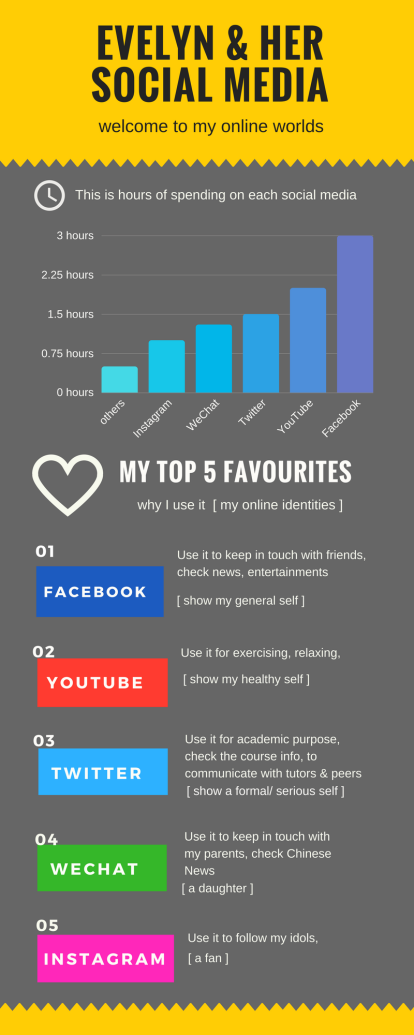
When it comes to online identity, my first online identity was created 7 years ago and originally comes from Facebook, as I remember at that time Facebook was very popular and my Facebook account was created by my friend who also taught me how to use it. At that time, I found Facebook very interesting and greatly attracted by it, after that, I started to discover more (social media) like Instagram, WeChat, Skype, YouTube, Twitter and so on. I have to say spending hours on these social media has become a routine for me because I am not living in one world, I am living in two worlds now, physical world and virtual world, so it is necessary for me to visit my virtual world as frequently as I could, and it is also the place where my online identity comes from.

RansoM Directive

“Evelyn & her social media” by Evelyn Tang, 02 December 2017, made with canva

tweet embedded from my Twitter profile @Evelyn_Tris, December 2017

However, I have several social media accounts and only Facebook I own three accounts, and in each account, my online identities are different (some are slightly different). For example, like Twitter, even though I just created in recent years but I have to say it is really a helpful tool for academic purpose and practical application, I use twitter for study purpose, I really like the unit hashtag which allows me to stay up to date with the course information, it is also a creative and convenient tool for me to discuss with my peers and to share my ideas, so in twitter world I think I am a student. Moreover, I am a normal user in WeChat world, I have it several years ago and I only use it for keep in touch with my parents and to follow some Chinese news. YouTube is one of my favourite media platforms and I have an account for many years now even though I am not a YouTuber. YouTube for me is a place that I can relax, it only shows what I like to watch after I subscribed to my favorite channel like fitness, healthy cooking, beauty, fashion and entertainment, I can say that I become healthier and happier each time after I watched YouTube because it encourages me to follow them. However, the Research shows that when people using social media, the positions, interactions and categories that create one’s identity always remain the same (Brown 2012, p. 169). Therefore, although I perform differently on different platforms, but both my online and offline identities are the same they are all me —the ‘real’ me, I never wanted to be another person online.

IMG_7984

Photograph by Evelyn Tang, 01 December 2017. Image of pink mouse & laptop

According to Brown (2012, p. 169), people like to think of themselves as being built by one ‘true’ self (the real me). This concept is, with some reflection, quite simplistic, as each person’s ‘self’ is both multifaceted and continually changing. Moreover, Thwaites et al. cited in Brown (2012, p. 169) also point out that, ‘one’s identity is a unique conglomeration of elements, a social composite. This social composite is built up from the interactions between the roles an individual adopts, the social positions one occupies and the categories one is placed in’. These elements always shift over time as our identities are rebuilt. Therefore, my online and offline identity is constantly changing, as time goes on.

tweet embedded from my Twitter profile @Evelyn_Tris, December 2017

Moreover, my online identity is not unchangeable even though it is on the same media platform like Facebook. I remember the first 2 years of using Facebook I was a true watcher (even now I am still watching) I rarely posted things especially the pictures of myself because I wanted to give people a mysterious sense (I don’t know if anyone found it mysterious) so I only used my favorite cartoon character as my profile picture, but years later I started to post lots of things on Facebook like my own images, status and so on, however, most of the things that I posted were complaining status, in other word, I treated Facebook as a doormat, afterwards, things have changed I no longer posted any complaining sentences because I found it useless and only showed a weak side of me. Therefore, since then, I only post happy and beautiful things, the purpose is to tell people that I am enjoying the present but it does not mean that my online identity is stopped changing.

37728713805_d52d6e2bea_z

‘phone’ by Tayloright (CC BY 2.0)

I have to say that I am very addicted to every kind of social media platforms and I am well aware that none of them are 100 percent safe, I think this is because of ‘internet affordances’. As Rak & Poletti (2013, p. 5) claim, ‘internet affordances help to determine how we will act online because they guide us to behave in a certain way or be a certain type of people’. The continual directive to ‘share’ personal information on social media sites like Linked In and Facebook is an example of media affordances which always ask the users to create a certain type of identity, one that can be shared. In the same way, the categories of life writing like daily or memoir build the terms within which people build identities, internet affordances can work (sometimes secretly) to build the rules for social interaction and the terms for identification. Therefore, affordances are a significant aspect of studying the ideological aspects of the production of online communities and online identities.

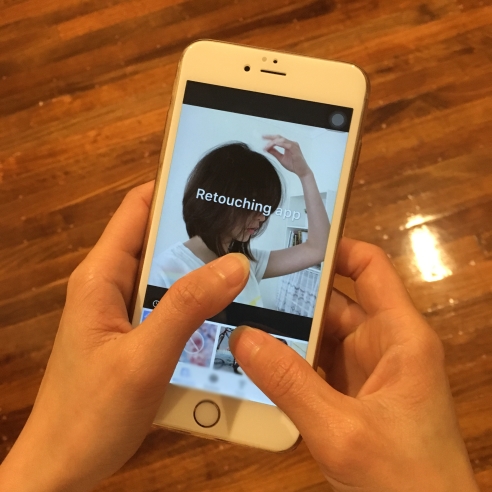
Additionally, according to Brown (2012, p. 169), we “manage” our real would identities every day, for example, we get dressed for parties, work, for university.  In the same way, ‘considerations of our audience and the expectations might have affected the way we present ourselves online’. Therefore, when it comes to posting images or selfies on the social media, for me, I never post my selfies and images without retouching or make-up, to be honest, I am pretty scared of my friend or someone post the ugly pictures of me and tag me in. I know it is not a good thing to show only the pretty side of me, which is actually quite tiring, however, like Brown (2012, p. 169) states, considerations of my audience and the expectations have affects the way I present myself online.

tweet embedded from my Twitter profile @Evelyn_Tris, December 2017

IMG_7986

Photograph by Evelyn Tang, 01 December 2017. Image of retouching photo

As Lanier (2010) states, ‘the small changes in the details of a digital design can have profound unforeseen effects changes on the experiences of the humans who playing with it’. For example, when Facebook began to have a ‘live’ function more and more people in Cambodia (my home country) or perhaps in Southeast Asian use it as a commercial tool to advertise their product because it is a low-cost method which allows anyone can be an online seller and people can easily attract by this new way of advertising, every time I see a growing number of people in Cambodia become an online seller through the use of ‘live’, I always think that maybe I would become one of them too if I do not study abroad.

To sum up, the internet has brought innumerable benefits to people, especially a second self—‘online identity’. My online identity has become an important part of me since the moment I created it, I cannot imagine if someday these social media no longer exists, I would suddenly loose in my mind and feel like something is missing, I can say that this is not a full me if my online identity is missing.

 (1185 words, not including citations and captions)

My Twitter profile (-: 

Reference:

Brown, A 2012, ‘Social Networking and social Norms: Be Nice or I’ll delete you’, Communication, New Media And Everyday Life, Oxford University Press, South Melbourne, Vic, pp. 165-176.

Lanier, J 2010, You Are Not a Gadget: A Manifesto, Allen Lane, London.

Rak, J, & Poletti, A 2013, ‘introduction: Digital Dialogues’, in Rak, J, & Poletti, A, Identity Technologies: Constructing the Self Online, The University of Wisconsin Press, Madison, pp. 3-11.

Creative Commons:

Tayloright, 2017, ‘phone’, Flickr, retrieved 02 December 2017, <URL>.


‘5 MINUTES WITH 4 CORRESPONDENTS’ – ALC205 GROUP PROJECT

By Amber Dew, Anna Black, Soueang Tang (Evelyn), and Hannah Kenny

In considering an idea for Assignment 3, it was suggested to fellow members of the team that we should focus on a topic whereby we find ourselves engrossed within the particular digital culture in which it has been technologically established. Immediately after identifying this, it became evident that dissecting the issue of social media, digital technology and surveillance would be an ideal pathway to explore creative and academic concepts in a unique and interesting way.

From the onset, constructing a ‘60-minutes style’ documentary was considered to be the most efficacious option by all group members, and thus was immediately our primary course of action. This was specifically due to three key reasons: it allowed us to interrogate and illustrate scholarly research; it allowed for the employment of both creative and analytical practices in the production of the video; and it allowed us to easily and effectively consolidate our ideas in order to accommodate the concern of working collaboratively from a distance.

The idea shifted from, simply, ‘documentary,’ to ‘60-minutes style,’ in order to compliment the idea at the centre of the video: surveillance, social media and digital technology. It was soon decided that specific focus should be placed on the issue of hacking as a crucial constituent of this topic. In contemporary society, social media platforms and digital technologies are synonymous with surveillance; anyone with a digital device is performing surveillance, or is susceptible to being surveyed, simply by constitution; respectively, hacking is a problem which follows suit (Hier, Greenberg 2009, p.g. 15, 205).

As discussed by Hannah, “Having written about social media use a handful of times before, I have found that it is rather easy to interconnect personal experiences when researching the workings of social media. Given that our group discussion grew from Facebook to Microsoft Teams, it was a “no-brainer” to focus on varying personal, invasive issues that can arise from social media use”. 

Through an analytical outlook, the ‘60-minutes style’ documentary allowed for the exploration of the intrapersonal implications caused by hacking, with each group member acting as a victim of hacking in varying scenarios. Moreover, creating a news segment style video was an intricate way to explore different experiences that can emerge from existing with an online identity. Each member was individually assigned to consider a conflict of interest that could potentially occur from using any kind of social media platform, or simply from using their digital device to store personal information. Taking inspiration from real life issues, this process was achievable and practical whilst also allowing each group member to think in an imaginative way.

Through a creative outlook, the ‘60-minutes style’ documentary could accommodate the notion of ‘anonymity,’ which conventionally coincides with ideas pertaining to online activities and surveillance (Hier, Greenberg 2006, p.g. 226). It was decided that each group member has the option of choosing whether to be ‘anonymous,’ in order to consider the exploitation of one’s identity that occurs in instances of hacking, or to be ‘identified,’ in order to express some degree of resistance against the personal repercussions of hacking. Thus, the video emphasised the precarious manner in which hacking is able to be achieved by virtue of social media platforms, digital technologies and surveillance practices.

Following the decision to go ahead with a news segment style video, whereby victims of hacking were interviewed, each individual group member created their own scenarios to be scripted. In order to ensure we didn’t mimic each others work, we used Google Docs to copy and paste our scripts for peer viewing. To minimise embarrassment for those who are camera shy, we decided that our news piece would be rather mysterious, intensifying the mood and putting the notion of invasion in the spotlight. Moments before it was time to individually film, we faced a minor dilemma. Anna had suggested that having multiple interviewers may seem confusing to the marker/audience. We collaboratively brainstormed ideas together including;

  • having a voiceover of the interviewer
  • nominating one group member to take on the role of being the interviewer
  • eradicating the interviewer role and using text to prompt the question
  • or being both the interviewer and the victim in our individual videos

After a long discussion throwing ideas to-and-fro, we concluded that we would either take on the role of being both the interviewer (audio only) and the victim or we would organise for a friend or family member to play the role of the interviewer to prompt the questions for the victim (ourselves). From this, we decided to relabel our news segment, identifying it as a documentary mini series with 5 journalists conducting interviews with 5 different victims of hacking around Australia. Anna edited her scripted introduction to make this clear, guaranteeing for a consistent flow in our video.

3302687999_fe9a7dddff_z

Interview by mattpursley (CC BY 2.0)

Editing and combining our individual videos together was the final part of the production process. As this required the effort of only one individual, Evelyn volunteered to undertake this job. It was necessary to select an image and song which would provide the video with an overall theme. Obeying copyright laws was a vital consideration when selecting these components, as copyright laws constitute the ownership of one’s original work. Therefore, it was necessary to dedicate significant time to finding the right image and music for the video which attained the appropriate CC licenses for usage. After the image and music was chosen, the editing and combining process went very well.

In order to make it clear to the viewer that there are two different roles ‘the interviewer and the victim’ in each story, Evelyn included a title next to both roles. After spending hours on clipping and rendering, the video was finally ready to show the other group members. Evelyn uploaded the video onto YouTube and sent a link to the group’s Microsoft Teams conversation, so that each group member could see it. It was agreed that Evelyn had done an incredible job in this final part of the production process. Evelyn raised her concerns about the exceeded time frame, and the group collectively agreed to brainstorm a way to cut down the length without impacting Evelyn’s edits. Anna downloaded the video file and cut any nonessential clips out of the introduction, conclusion, and interviews, which resulted in the video adhering to the expected time limit. This was then sent back to Evelyn, who reviewed this work before uploading the final product onto YouTube once more.

Ultimately through watching the video, we hope our audience can consider the implications that can derive from social media and digital technology usage. Though the scenarios in which we have delivered in our news piece may appear somewhat extreme, many social media and digital technology users demonstrate concerns about their privacy online, however do not engage in privacy protective behaviours, meaning their security online can be compromised (Quinn, 2016). 

Word count: 1099 (not including captions and citations)

REFERENCES:

Hier, SP & Greenberg, J 2009, Surveillance: Power, Problems, and Politics, UBC Press, retrieved 19 September 2017, <http://ebookcentral.proquest.com.ezproxy-f.deakin.edu.au/lib/deakin/reader.action?docID=3412645 >.

Quinn, K 2016, ‘Why We Share: A Uses and Gratifications Approach to Privacy Regulation in Social Media Use’, Journal of Broadcasting & Electronic Media, vol. 60, No. 1, pp.61-86, retrieved 19 September 2017, HeinOnline, EBSCOhost.

VIDEO REFERENCES

Video image: ‘NEWS‘ by Robert Hruzek (CC BY-NC-ND 2.0)

Video music: ‘more weird news music stuffs >.<‘ by Matthew Wins Music (CC BY 3.0)

Is it a good or bad thing to have a lot of CCTV cameras in schools?

With the development of technology, we come to realize that we are living in a culture of surveillance, being watched sometimes become a normal thing to most people, but in some cases, this normal thing did not completely accept by everyone. Do not know when a beginning, schools were turning to technology to keep an eye on their students and staffs.

IMG_4586

Photograph and Illustrate by Evelyn Tang, 02 September 2017

This is not surprising that many countries are increasingly utilising surveillance devices (CCTV cameras) in schools to tackle and control every sort of problems, like obesity, bullying, truancy and smoking (Taylor 2013). Furthermore, CCTV is a significant equipment for managing risks, reducing crimes and helping social control within educational establishments. With mention to access control, CCTV is not only used to prevent those trespassers or outsiders from getting in but also to control students who come late as part of a disciplinary discourse (Hope 2009, p. 904).

However, at first, the purpose of CCTV cameras placement only focused on protecting the area or perimeters of schools against trespassers and intruders, but soon cameras were installed in the Libraries, computer rooms and corridors of many educational institutions. CCTV also crept into more controversial school spaces, like students’ classrooms and even in the toilets (Hope 2009, p. 892).

IMG_4588

Photograph and Illustrate by Evelyn Tang, 02 September 2017

Let talk about the CCTV in the classroom first. Does the camera in the classroom change the way in which staffs teach? And what about the students? what is the attitude they should take to face with CCTV? Under the surveillance, most of teachers and staffs have to be more mindful of the fact that they have to be professional at all points and very mindful of the way they speak and the way they address the students. Additionally, CCTV in the classroom not only put every student on their best behaviour it also leads to a better and safer learning environment for every student, and importantly, it makes teaching easier for the teacher.

Back to 9 or 10 years ago, school was a very different place from now, there were more fights, abuse, bully and so on. But ever since the CCTV came in everyone’s been calmer and quieter, you can feel that it has been more safety. For example, if something happened like a fight, some burglar or something, it will be easy for teachers to see what is going on or who did it, but this is just a point of view from some students (Nemorin 2017, p. 244).

IMG_4587

Photograph and Illustrate by Evelyn Tang, 02 September 2017

Another point of view is CCTV camera is an object that encroached on student personal privacy, in another word, a large part of student’s privacy has been violated (Nemorin 2017, p. 243). In schools, they are under surveillance all the time no matter where they go, even in the toilets (if it happens).

It is acceptable to have CCTV in the classrooms, libraries, corridors, everywhere in schools but except toilets and changing rooms, I don’t think it is necessary and acceptable to have CCTV camera in the toilets and changing rooms, it would cause a number of concerns and worries for every student and student parents. Think it this way, if your favourite restaurant put a CCTV cameras in the toilets, would you go there again for dinner?

word count: 518 (not including captions and citations)


Citation:(Nemorin 2017, p. 251-252)

Podcast Music: ‘Inspirational Life’ by  Royalty Free Music (CC BY-SA 3.0)

Podcast Image: ‘School’ by Alan Levine (CC BY 2.0)


Reference list:

Hope, A 2009, ‘CCTV, School Surveillance and Social Control’, British educational research journal, vol. 35, no. 6, pp. 891-907, doi:10.1080/01411920902834233

Nemorin, S 2017 ‘Post-panoptic pedagogies: the changing nature of school surveillance in the digital age’, Surveillance & society, Vol. 15, No. 2, pp. 239-253, retrieved 30 August 2017, <ezproxy.deakin.edu.au/login?url=http://search.ebscohost.com/login.aspx?direct=true&db=i3h&AN=123305448&site=eds-live&scope=site.>.

Taylor, E 2013, ‘School surveillance puts trust at risk’, The Sydney Morning Herald, 8 OCTOBER, retrieved 30 August 2017, <http://www.smh.com.au/comment/school-surveillance-puts-trust-at-risk-20131007-2v494.html>.

Creative Commons:

Hendry, K 2010, ‘24 HOUR CCTV WITH SOUND RECORDING in a Bathroom!?’, Flickr, retrieved 29 August 2017, <URL>.

Levine, A 2012, ‘School’, Flickr, retrieved 29 August 2017, <URL>.

Royalty Free Music, 2016, ‘Inspirational Life’, SoundCloud, retrieved 29 August 2017, <URL>.


Have you watched or searched someone through social media?

Since social media has become popular in recent years, one part of our life is spent on online which is ‘fun’ for many of us. Social media are services where users dwell. For users, it is sharing, participating and so on. However, they also need to think carefully about the unexpected consequences of participating on new dwellings, otherwise, those transient activities are made permanent. The risk of exposure is tempered by privacy settings, but users cannot control others, also cannot control the purposes of people who control services like Facebook. Therefore, the more time the users dwell on Facebook, the more their lives are exposed (Trottier 2012, p. 7).


Surveillance is a basic quality of modern society and a consequence of historical processes of exclusion and inclusion (Wagenaar & Boersma cited in Fuchs 2012, p. 298). It has become part of a technical infrastructure, in which the few watch the many and the many watch the few (Lyon cited in Fuchs 2012, p. 298). Additionally, what makes the internet special is because the surveillance becomes mediated by a technology that changes social order by transcending space and time, it makes interaction and networking over long distances possible, moreover, Surveillance can take place from any location and at any time (Fuchs 2012, p. 298).

tweet embedded from my Twitter profile @Evelyn_Tris, 10 August 2017

Are we under the surveillance? Well, not exactly, because we are also doing the surveillance. In general, surveillance also refers to the sustained and targeted collection of personal information which is also an enduring process. However, surveillance becomes a thing that everyone concern because of privacy violations, and the tweet below shows the example of this.

tweet embedded from my Twitter profile @Evelyn_Tris, 10 August 2017

Today, it seems normal (maybe) to searching someone name through social media, and somehow it becomes natural (maybe) to do what people call “tracking” and “monitoring” others online. However, like Facebook, after you have visited his or her profile, Facebook always suggest his or her friends to you, such as “people you may know” or “Facebook friend suggest”.

3431845546_a932afc10d_o

Facebook Friend Suggest FAIL‘ by Jesús Gorriti (CC BY-SA 2.0)


4309537505_50466e87f4_o

Facebook friend suggest‘ by Matthew Burpee (CC BY-NC-SA 2.0)

Moreover, Facebook usually tries to advertise us something that bases on our interested. For example, if you click like on a makeup page, then it started to show you cosmetics ad. Sometimes you will find it baffling or began to wonder whether we are under the surveillance of Facebook? In fact, Facebook hides an opt-out option from cookie-based advertising deep in its privacy policy which only offers a minimum of advertising privacy selection in its settings. Facebook participates in a long-term surveillance of usage behaviour and user data in order to sell these data to advertising buyers that offer targeted advertising to Facebook users (Fuchs 2012, p. 35).

However, here I want to make a short explanation of these “data”. Generally, in our daily life, I believe we have at least one interaction with a ‘little brother’. Have you used Twitter or Facebook, or watched a YouTube Video, used a tollway, logged on to e-banking? If you have done these, then in each activity a little brother silently watched, cached and archived your activity as data. The collection and processing of data is global growth phenomenon, heralding a new era in manufacturing: the production of data is mainly gathered by way of surveillance (Chalkley 2012, p. 207).

Finally, I want to suggest that our online and offline lives have blended into each other so much which we really have to consider of there being a digital dimension to our human lives now.

word count: 528 (not including captions and citations)

Reference list:

Chalkley, T 2012, ‘Surveillance: Why is Everybody Staring?’, Communication, New Media And Everyday Life, Oxford University Press, South Melbourne, Vic, pp. 201-214.

Fuchs, C 2012, Internet and Surveillance: the challenges of Web 2.0 and social media, Taylor and Francis, retrieved 30 July 2017, <ProQuest Ebook Central (owned titles)>.

Trottier, D 2012, Social Media as Surveillance: Rethinking Visibility in a Converging World, Taylor and Francis, retrieved 29 July 2017, < ProQuest Ebook Central (owned titles)>.

Creative Commons:

Burpee, M 2010, ‘Facebook friend suggest’, Flickr, retrieved 01 August 2017, <URL>.

Gorriti, J 2009, ‘Facebook Friend Suggest FAIL’, Flickr, retrieved 01 August 2017, <URL>.

Schiller L. A, 2009, ‘all2gethernow: Social Media Monitoring’ Flickr, retrieved 01 August 2017, <URL>.

We gradually became accustomed to the surveillance


meduim

surveillance“, by screenpunk, (CC BY-NC 2.0)

In recent years because of the development of technology, people’s life and property security have been improved accordingly. However, the improvement of people’s security does not mean that there is no danger or crime at all. Therefore, in order to protect people and public property safety, the number of CCTV devices has also been increasing too. CCTV camera is one of the security tools that can produce images or recordings for Surveillance purposes which helps in crime prevention and also solve problems with accident cases.

Additionally, it depends on the Public Order Situation, the more criminal cases happened the more CCTV cameras and police officers. Moreover, one thing that comes to my mind is when people commit a crime why are they really sure that no one would see them? how can they be so sure about that? because in the end, most of them still under arrest. However, I believe some of them knew that they are under surveillance or knew that there is a security camera (CCTV), but they still want to take a risk.


Buildings, temples, offices, some street areas or any other public places, all of these places are always have CCTV cameras, in other words, there are CCTV cameras everywhere. In addition, we should aware that we will be watched all the time in anytime and anywhere, and I believe most people know that. Moreover, in school area definitely have CCTV cameras, but why are most students still surprised when they know that there is a CCTV camera in front of the classroom or sometimes inside the classroom because they never thought that how come a school has so many cameras. Especially, when the camera reveals in the places that it should not be revealed then the student start feeling creepy.

tweet embedded from my Twitter profile @Evelyn_Tris, July 2017

Actually, when we take a train every day to work, there are CCTV cameras in the train station, when we go to visit a doctor, there are CCTV cameras in the hospital, and of cause when we withdrew money from a bank there are a numerous CCTV cameras there, if the bank doesn’t have CCTV cameras I don’t think people would call it bank. So yes, we all know that there are CCTV cameras in these places, it is just because we did not pay attention to. When faced with too many surveillances we gradually became accustomed to it, in fact, we all know that we are being watched, just because we did not take it seriously.